

FROM TOM MARSHALL
[If you would like to contribute to Langford Nature Notes please contact Richard on richard@kempsyard.uk]
I am often asked what the difference is between Swallows, Swifts and House Martins. Living in Langford (surrounded by a dairy farm that produces copious amounts of flies) we are blessed with an abundance (although unfortunately decreasing) of these fantastic little birds whose arrival back from Africa in April and May is one of my highlights of the natural year.
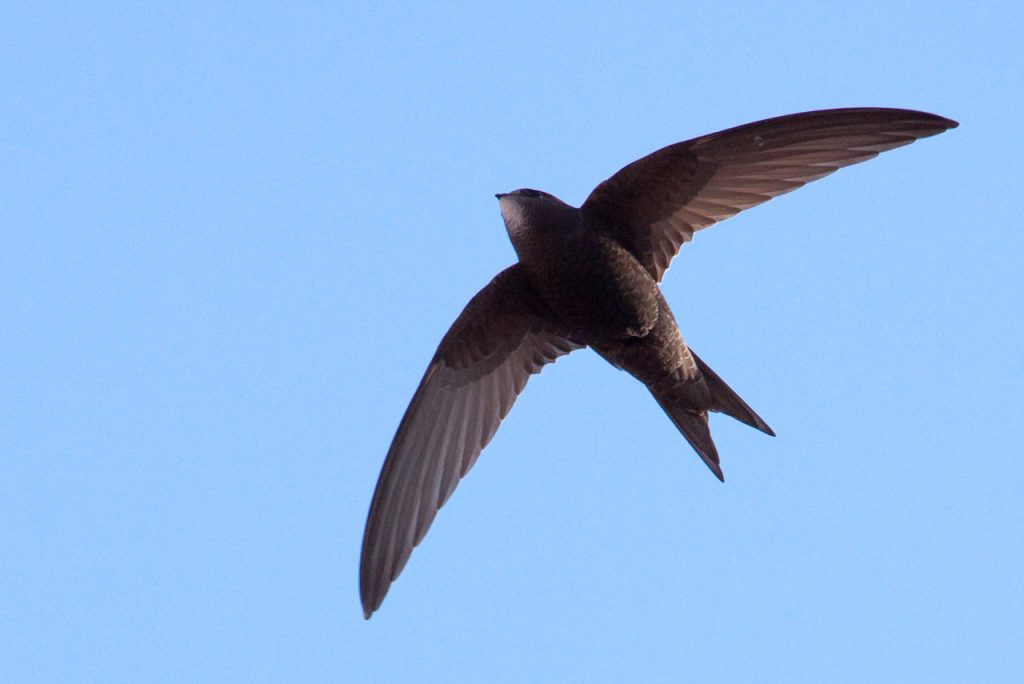
Swifts are dark brown but look mostly black against the sky – no white markings – but pale under chin which is not visible at a distance! They are bigger than Swallows and House Martins and have long, pointed scythe like wings which they don’t close when flying (Swallows and Martins do). Forked tail but with no streamers. You will never see them sitting on roofs or overhead wires or for that matter roosting or sitting anywhere. Nests under tiles in roofs, in church towers and other similar nooks and crannies – usually fairly high up. The Old Smithy and Pember Cottage are 2 places where they have nested for at least the last decade. Most nest sites are on North or NE or NW aspects. South facing roofs are too hot. Length (tip of beak to tip of tail) 16-17cm. Wingspan 42-48cm. 1 brood 2-3 eggs. Can live up to 20 years.
Swallows are smaller than swifts and have whitish or light rusty underparts. Dark blue upper parts – no white! Deep rust coloured chin with dark blue chest band under chin. Long tail streamers. Often seen on overhead wires, sometimes, especially in late summer in large numbers. Nests inside buildings such as barns, stables and garages etc. Length 17 – 19cm. (Inc. streamers) Wingspan 32 – 35cm. 2-3 broods 4-5 eggs. Can live up to 16 years.
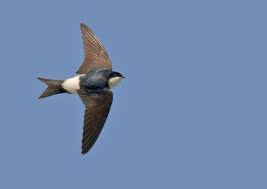
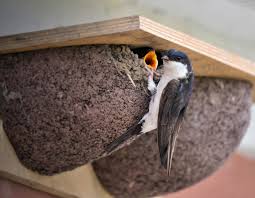
House Martins (pictured on the wing at the head of this post) are slightly smaller than Swallows with distinctive white rump and white undersides including throat. Brown-black upper parts and wings. Forked tail but no streamers. Looks chunkier than Swallow in flight. Nests on the outside of buildings in a mud cup shaped nest tucked in under the eaves. Length 12cm. Wingspan 26 – 29 cm. 2 -3 broods 4-5 eggs. Can live up to 7 years.
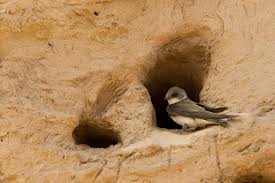
The House Martin has a close cousin in the Sand Martin. These can be seen along the Thames and are usually seen near water. They nest in holes in sandy or earth banks. About same size as House Martin but no white rump. Brown upper parts and wings. White underparts with brown breast band. 1-2 broods 4-5 eggs. Can live up to 7 years.
When flying Swallows tend to be the closest to the ground, Swifts tend to fly the highest and House Martins will be in the middle. This is not definitive!
Swifts (scientific name Apus Apus) are unique amongst birds as they spend most of their non breeding time on the wing. When the fledging swift leaves its nest in late June or July it will not land until it is mature, 3 or 4 years later. They will eat, drink, sleep and even mate while on the wing. Remarkably, these birds can retain their navigational ability while in REM sleep.This technique of sleeping is called unihemispheric slow-wave sleep (USWS), which allows one half of the brain to enter into deep sleep while the eye corresponding to this half is closed and the other eye remains open. Apus, from Ancient Greek, loosely translates as without feet. Swifts have very small, fairly weak feet and they were originally deemed to be legless Swallows.
Swifts arrive in late April but are not often seen here until the first or second week in May and they are one of the first migrants to leave in mid August. As they live entirely on the wing daylight ours are important. Ours leave in early August when daylight hours start to drop below 17 hours. They stay longer in northern parts of Europe (lighter for longer). Swifts winter in sub Sahara Africa and one tagged Swift returned from Western Africa to the UK in 5 days covering 3500 miles.
Swifts are the ones that scream around the village in groups. These are probably non breeding birds and they are said to scream loudest when zooming past nesting swifts who return their calls. These birds are also prospecting for nesting sites for when they reach maturity.
Swifts are now on the Amber list as a declining species, 45% reduction in numbers in the last 20 years. One possible cause is a lack of breeding sites – as buildings are reroofed historic nesting sites disappear. Nicky and I have recently put up a bespoke nesting box for them on the end of Wren Barn.
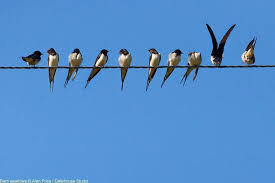
Swallows, or Barn Swallows as they are called in Europe, are also on the Amber list. Probably for the same reason as Swifts but decreasing numbers of insects might also be causing problems. Swallows also migrate to Sub Sahara Africa, our swallows going to South Africa. They migrate in daylight and cover about 200 miles a day, taking a leisurely 6 weeks.
House Martins are also on the Amber List for the same reasons as their cousins. Remarkably for this day and age no one knows where they migrate to. No doubt somewhere in Sub Sahara Africa. One theory is that they winter high over the remote tropical rain forest of the Congo rarely landing. The only ringed House Martin (out of several thousand) caught south of the Sahara was found in Nigeria. Or maybe the old naturalists were right and they hibernate at the bottom of ponds!
The Sand Martin is currently classified as Green – no immediate concern. Winters south west of the Sahara mostly around the major river systems.
One thought on “LANGFORD NATURE NOTES – Swifts, Swallows & Martins”
Saw 2 Swifts over Langford early this morning.
Tom Marshall 9/5/19